
Telemedicine at Altitude: Closing the Clinical Gap in Emergency Air Transport
Ask an emergency physician where patients are lost, and the answer is rarely the resuscitation room. It is the gap — the unsupervised minutes between the emergency call and the arrival of definitive care. Air ambulances shorten that gap geographically. Telemedicine shortens it clinically. The next generation of aeromedical services must do both.
The anatomy of the gap
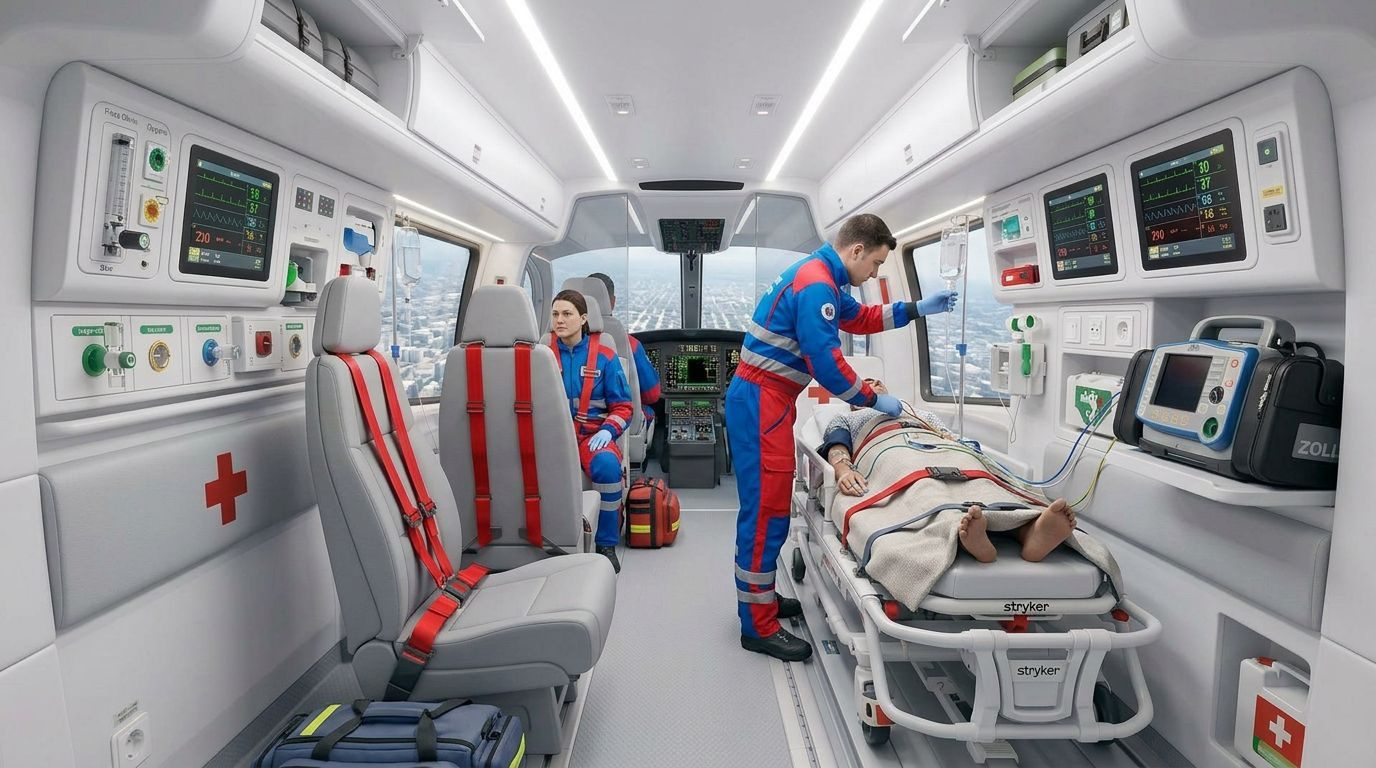
In a conventional HEMS mission, clinical expertise arrives with the aircraft. Until the crew is on scene, the patient depends on whatever care bystanders and first responders can deliver unguided. In flight, the crew works alone: skilled, but disconnected from the receiving hospital's specialists and systems. At handover, information is compressed into a hurried verbal report.
Each of those moments is a point where outcomes are decided. The evidence is not subtle:
- Bystander CPR guided by phone triples survival from out-of-hospital cardiac arrest compared with unguided response.
- Haemorrhage control within three minutes reduces blood loss by roughly 40% — and haemorrhage remains the leading cause of preventable trauma death.
- Structured pre-arrival information measurably reduces time-to-intervention at the receiving emergency department.
Designing the connected mission
The model we have built into Aurenda treats telemedicine not as equipment on the aircraft but as the operating system of the mission. The timeline looks like this:
- T+0 — the call. Dispatch is activated and a remote specialist physician connects within two minutes, regardless of geography.
- T+2m — remote assessment. While the aircraft is still on the pad, the physician is guiding bystanders through CPR, haemorrhage control and airway positioning.
- T+8m — crew en route. The flight crew receives a full patient brief in the air. Equipment is readied; drugs are drawn before landing.
- T+15m — on-scene care. The HEMS crew delivers advanced intervention — anaesthesia, surgical airway, blood transfusion — with specialist oversight on the link.
- T+25m — stabilised and flown. Continuous monitoring streams to the receiving hospital, whose team is briefed and ready on landing.
The aircraft shortens the distance. The link shortens the time. Together they compress the interval that kills.
Why the platform matters
Connected care assumes you can reach the patient at all. This is where aircraft capability and clinical strategy intersect: a platform that can land on rooftops, roadsides and confined rural sites — as the hybrid-VTOL Avectra 101 can — turns the telemedicine timeline from a best case into a standard operating picture. And an operating cost measured in hundreds rather than thousands of euros per hour means the connected mission can be dispatched liberally, not rationed.
Beyond the aircraft
Perhaps the most important property of a well-built aeromedical telemedicine platform is that it does not care what vehicle it rides in. The same clinical infrastructure that supervises an Aurenda flight can license to ground ambulance fleets, remote industrial sites and international operators — extending specialist reach into every setting where the gap exists. That is why we describe Aurenda as a complete clinical solution rather than an air ambulance service: the aircraft is the most visible component, but the connected clinical model is the product.
Healthcare systems measure what they fund. As commissioners increasingly evaluate emergency services on outcomes rather than response times alone, the services that close the clinical gap — not just the distance — will define the category.
Learn more about Aurenda Air Ambulance or contact the clinical partnerships team.