
Hybrid VTOL: The Third Path Between Helicopters and eVTOL
The vertical-flight debate has hardened into two camps. On one side, conventional helicopters: proven, capable and expensive. On the other, battery-electric VTOL: clean, quiet and perpetually five years away. Between them sits a configuration with the operating economics of neither camp's worst case — and remarkably little attention.
The eVTOL problem nobody has solved
The engineering case for electric air taxis founders on a single number: specific energy. Aviation fuel stores roughly fifty times more energy per kilogram than the best certified lithium-ion cells. Every gram of battery a designer adds to extend range must itself be lifted, in a compounding spiral that caps practical endurance at levels that constrain real missions — before accounting for reserve requirements, battery degradation and the certification questions that surround high-discharge flight profiles.
None of this makes electric flight impossible. It makes it late. Operators with missions to fly today — medical, security, industrial, mobility — need vertical capability with endurance, payload and certification pathways that exist now.
The helicopter problem everybody has normalised
Meanwhile, the incumbent solution costs €2,000–€4,500 per flight hour to operate. The rotor system that gives a helicopter its vertical capability must be powered, articulated and maintained through every minute of every flight — and the mechanical complexity that implies (transmissions, tail rotor drives, frequent overhaul cycles) is the direct cause of both the cost structure and a significant share of the accident record. The industry has treated these numbers as the price of vertical flight for so long that they have stopped looking like a design choice.
The helicopter pays for its vertical capability every minute it flies. The hybrid gyroplane pays for it only in the minutes it is actually using it.
The third configuration
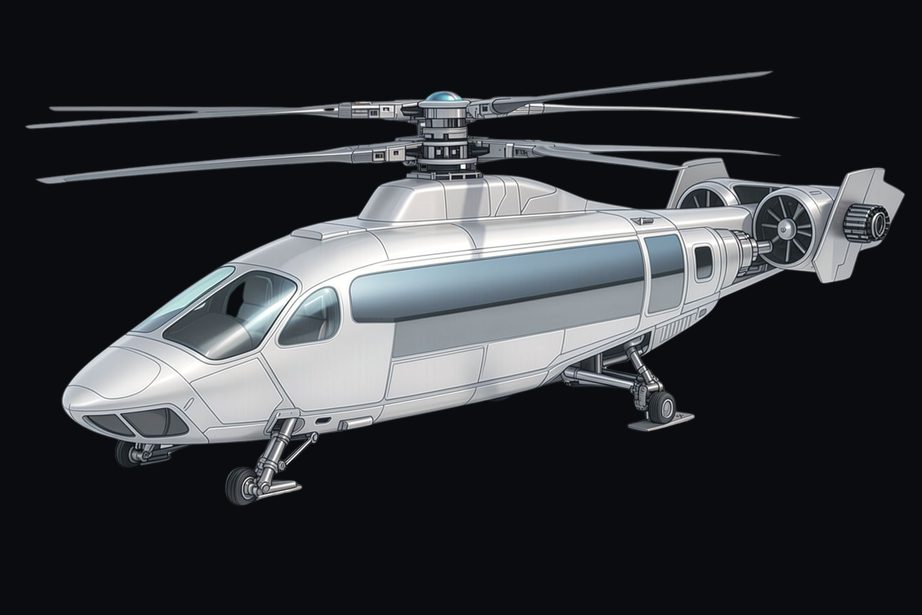
The hybrid gyroplane-helicopter splits the flight into two regimes and gives each one the right physics:
- Take-off and landing — helicopter mode. The rotor is powered, enabling true vertical operations from rooftops, roadside sites, mountains or helipads. No runway; no large cleared landing zone.
- Cruise — gyroplane mode. Power to the rotor is removed and it autorotates freely, generating lift from the airflow itself while a propeller provides thrust. The result is an inherently stable, low-drag flight profile with 35–40% lower fuel burn — and an aircraft that responds to engine failure with a controlled glide rather than an emergency.
The economics follow the physics. With the rotor unpowered for the vast majority of the mission, transmission loads, component stresses and maintenance cycles all fall. Our Avectra 101 programme targets an operating cost of €320 per flight hour — a 94% reduction against incumbent helicopters — using certified propulsion technology and conventional fuels available at any airfield today.
What the third path unlocks
Cost reductions of this magnitude do not merely improve existing missions — they create new ones. Air ambulance coverage becomes affordable for health systems that could never fund helicopter EMS. Aerial security and inspection can run persistent schedules rather than exceptional sorties. Regional point-to-point mobility starts to compete with ground transport on total cost, not just time.
And because the configuration burns conventional fuel through efficient engines rather than waiting on battery chemistry, its sustainability gains — 35–40% lower fuel per mission — are deliverable this decade, with a clear pathway to sustainable aviation fuels as they scale.
An honest assessment
The hybrid configuration is not the answer to everything. It will not match a heavy twin's cabin volume, nor an eVTOL's noise signature in dense urban cores. What it offers is different: vertical access, inherent aerodynamic safety and operating costs an order of magnitude below the incumbent — using engineering that certifies on today's rules and flies on today's fuel.
The future of vertical flight is usually presented as a choice between the past and a promise. We think the more interesting answer is the one in the middle — and we are building it.
Explore the Avectra 101 and the Avayu, or talk to the Fixius programme team.